Category: Storytime

  • The first No Blocker

    The first No Blocker

    May 20, 2026 | Storytime | ~6min read time

    Everything has an origin. The story of No Blockers, Antwerp’s first international volleyball club, begins thousands of kilometres away in Homs, Syria, where our founder Sohel Zin Alaabidin lived the first part of his life. This is the story of the first No Blocker; this is our story.

    The past shapes the present

    I inherited the passion for volleyball from my father. My father was a volleyball player at Al Karama Club, Al Karama Club, one of the most historic and successful sport clubs in Syria. Founded in Homs in 1928, Al Karama built a long legacy through numerous national titles and generations of athletes who represented the club across different sports, especially volleyball. My father regularly took me with him to the men’s training sessions from a young age not to watch, but to train.

    Left: My father playing for Al Karama Volleyball Club in Homs, Syria
    Right: Al Karama Club logo

    At the age of 14, I officially began playing with the men’s team, alongside my father. Looking back at our time at Al Karama, I sometimes wonder how far that path could have gone under different circumstances.

    Receiving my first medal as a volleyball player

    But with the beginning of the 2011 Syrian war, everything changed in an instant. The fields were closed and daily life itself became unstable. Everything that happened during and after that war completely changed the course of our lives.

    During that period, I started discovering who I was outside the sports halls. At the time, I had two options: either I would side with the dictatorship and take up arms against my own people, or I would join the resistance and carry a weapon as needed defence. It was then that I realized I did not want to carry a weapon at all, no matter the reason. Instead, I chose to work with the Red Cross and carried out more than 600 missions, working on the ground to help people.

    With Red Cross colleagues in Homs, 2012

    I faced countless situations that nearly killed me, including a serious injury that left me close to death. I barely escaped but injured my shoulder and my thigh. Yet, after all those years, I was still ordered to immediately report for military service.

    This is when I knew that I had to leave Syria. I left everything and set out to cross the sea, not knowing if I would reach a place where I could live, or if my life would end right there in the sea.

    The beginning in Brussels

    When I arrived in Belgium in 2014, I was not completely detached from the war and everything that had happened. Despite this, near my apartment in Brussels was a small court where I would go to watch people play volleyball. Remembering and feeling my injury from back in Syria, I wasn’t sure I would ever be able to play again. But I gathered my courage and looked for a volleyball group to play with. The first time I stepped onto the court was overwhelming. I remembered who I was and for the first moment, I felt the power of that place. At first, I wasn’t at my best because I was still trapped in my thoughts. Then, with the first serve I made, everything came back to me in a second. From that moment, I began playing regularly and built wonderful friendships in Ghent, Leuven, Brussels and Antwerp. After a while, I moved to Antwerp for work and I began to build a community of volleyball-loving friends.

    No Blockers is born

    The friends I made in Antwerp came from all over the world, boasting 25 different nationalities. Somehow, that diversity brought us closer together. We started participating in tournaments in Belgium, Germany and The Netherlands. At some point, we realized we needed a name for our team. That’s when “No Blockers” was born. The name was inspired by the word “block” in volleyball, but for us it meant much more. Although we came from different cultures, religions and backgrounds, there were no barriers between us: No Blockers, so to say. What started out as a group of friends eventually evolved into something much bigger. In 2025, seeing how much love, energy, and time we all invested into the team, we decided to officially create No Blockers as Antwerp’s first international volleyball club.

    Our international No Blockers family

    A future we invite you to

    I once believed that my dream and my journey with volleyball had ended with the closing of those fields in Homs. But through the efforts of every member of No Blockers, my dream found its way into the light. By connecting our strengths and our love for volleyball, we created a new, more powerful path. Today, we want to leave a mark in this world for everyone who loves this sport, so that they will always have a place to play, a place filled with hope and life.

  • From Deurne to Dubai

    From Deurne to Dubai

    March 3, 2026 | Storytime | ~4min read time

    Once a No Blocker, always a No Blocker. Our middle blocker Ahmad moved from Deurne to Dubai in October. Here is how he kept his passion for volleyball and what has changed since his move.

    Adapting to the weather

    Firstly, Ahmad had to acclimatise to the desert heat during the day and the low temperatures during the night. Another change he made, very fittingly, was switching from indoor to beach volleyball. At this time of the year, Dubai sees around 30 degrees Celsius without a single cloud in sight. Playing at the shores of Dubai with sights like the Burj Al Arab nearby sounds tempting, given the sometimes depressingly grey winter weather here in Belgium.

    Changing habits

    Now, beach volleyball requires a different skillset than normal volleyball. Ahmad is using his experience as middle blocker to his advantage. With over 1.90m in height, blocking of course comes to him naturally and is his biggest advantage. Though he says that you need to be a lot more mobile and move around the field more when compared to indoor volleyball. It requires a certain “quick on your feet” mindset. He also says that you need to set a lot more, something middle blockers are acquainted to, but it is definitely not their core strength.

    Beach volleyball in Dubai

    Ahmad says that beach volleyball is pretty popular in Dubai. Most of the time he and his friends rent out a field privately. The are plenty of small private businesses that offer this service, but there are also publicly accessible fields. Sometimes, he just goes to the beach and finds people who are setting up their own net and then he joins the group.

    A vigorous No Blockers supporter

    Ever since he has moved, Ahmad is still supporting us and our mission in Antwerp. Our match livestreams, Instagram account and our WhatsApp community help him stay connected with the team and our challenges, wins and developments. Who knows, maybe one day we will open a subsidiary of No Blockers in Dubai!

    First steps in the sand for No Blockers

    On Saturday, March 7th, No Blockers will hold its first internal beach volleyball tournament in Leuven. Our players will have 4 hours of getting to know the basics and playing friendly matches against each other. Hopefully, this sets the first step towards 1 or 2 competitive beach volleyball teams for No Blockers in the next season, so stay tuned!

    Edit March 2026

    In light of the recent events in the Gulf region, Ahmad has let us know that he is safe and that life has somewhat adjusted to occasional alarms, strikes and interceptions. No Blockers wishes everyone who is affected by the conflict continued safety and a swift end to the violence.

  • Interview with head coach Mladen Vukasinovic

    Interview with head coach Mladen Vukasinovic

    January 26, 2026 | Storytime | ~6min read time

    Our players commit to two training sessions and one match per week. How does the organisation look like behind the curtains? How do we ensure the safety, physical stamina and technical and mental readiness of our team? Hear it from our certified head coach Mladen Vukasinovic, interviewed by Luka Vethake.

    Can you tell us about your passion for volleyball? When did it start and why has it remained such an important part of your life?

    My volleyball journey began more than 30 years ago in Belgrade, where I started playing with friends from school. My first club was called Block Out, which is an interesting coincidence given that I later became a blocker and eventually joined No Blockers.

    Early on, we achieved notable success, including winning a tournament that featured many of the strongest clubs in Serbia. That led to an invitation to train with Partizan, one of the most prestigious clubs in the country. Partizan played a significant role in shaping me both as a player and as a person. We competed at a high, professional level, but equally important were the friendships, travel, and shared growth. There is expression in Serbia: “Other clubs have supporters, Partizan is loved!”

    When I started university, I initially feared that my volleyball career might end. While I continued playing in second-league clubs, my university years turned out to be the most rewarding period. I played for the university team and competed internationally, traveling to cities such as Beirut, Valencia, Paris, Istanbul, and Milan, and we achieved strong results together.

    After moving to Antwerp four years ago, volleyball was something I truly missed—it is part of who I am. That search led me to No Blockers, where informal sessions evolved into a growing, structured club that continues to develop today.

    What motivated you to pursue the coach certification and how does the process look like?

    My primary motivation was to pass on the passion I have for volleyball. I have two children, and I strongly believe in sharing not only the sport itself but also the values behind it—teamwork, respect, and personal development.

    Volleyball in Belgium is very well organized, with leagues for all ages, from youth to veterans, and I wanted to be part of that ecosystem. I was also volleyball referee at national level in Serbia, but I ultimately chose to focus on playing and coaching.

    The certification process combined theory with strong practical elements. One aspect I particularly appreciated was the “learning by doing” approach. We were given real case studies—such as designing a warm-up—and worked in groups to deliver sessions, with other course participants acting as players. Each session was followed by structured feedback and discussions on improvement, new techniques, and modern training tools.

    It was a very supportive and collaborative experience, and I look forward to continuing my education as a coach.

    What is the training philosophy of No Blockers and how do you bring it to life on the court?

    Our training philosophy is built around three core pillars.

    The first is trust—building confidence, mutual respect, and strong bonds within the team. The second is experience. We aim to give every player meaningful playing time, regardless of background or level. This includes rotating systems extensively, using full rosters, and allowing players to experience different roles and match situations.

    Training is much more than physical or technical development. It is also where players get to know each other better, experiment with new ideas, and contribute beyond the court. For example, one of our players developed an internal statistics application, and others contribute through their professional expertise and experience.

    The third pillar is continuous improvement. As one of our players once said, “Volleyball is a game of fixing each other’s mistakes.” No one is perfect, and constructive correction—of reception, setting, or positioning—is essential to collective progress.

    Our biggest challenge at this moment is managing a very diverse roster. We have players with professional-level experience alongside others who have only recently started playing. Balancing training intensity and engagement for all levels requires thoughtful planning, individual attention, and additional friendly matches to support player development.

    What can we expect from No Blockers in the coming years?

    In the short term, our goal this season is clear: to win the league and the cup. We are currently leading the championship and remain focused on maintaining momentum while continuing to develop all players.

    Mid-term, within the next two years, we plan to launch a women’s section competing officially. We also aim to establish a youth section and further grow our club structure. Additionally, we are exploring the creation of a beach volleyball section, as we believe Antwerp’s international community would strongly benefit from such an initiative.

    We already participate in tournaments across the Benelux region and plan to expand internationally, including competitions in countries such as Germany, France, and Serbia.

    Looking five years ahead, we are ambitious. Our long-term vision includes competing at European level and contributing players to national teams. We also aim to expand the No Blockers concept beyond Belgium through international partnerships.

    We believe in dreaming big, growing together, and building something meaningful— both on and off the court.

  • How we as a small volleyball club use match data

    How we as a small volleyball club use match data

    November 11, 2025 | Storytime | ~5min read time

    Everybody was impressed by the accuracy and visualisation of match data during the FIVB World Championships this year. So how do we collect data, how do we use it and what does it mean for the team?

    Making data accessible

    Data has become a staple in professional volleyball. We are used to impressive animations of ball in/ball out, reception accuracy visualisations and seeing what positions the setter trusts in the most to make a kill. As a club in Sporta IV our means are limited, but not our willpower and imagination. Of course we do not possess wearable sensors, high-frame cameras and powerful statistical software, but we got our very own data-wiz; Fabio.

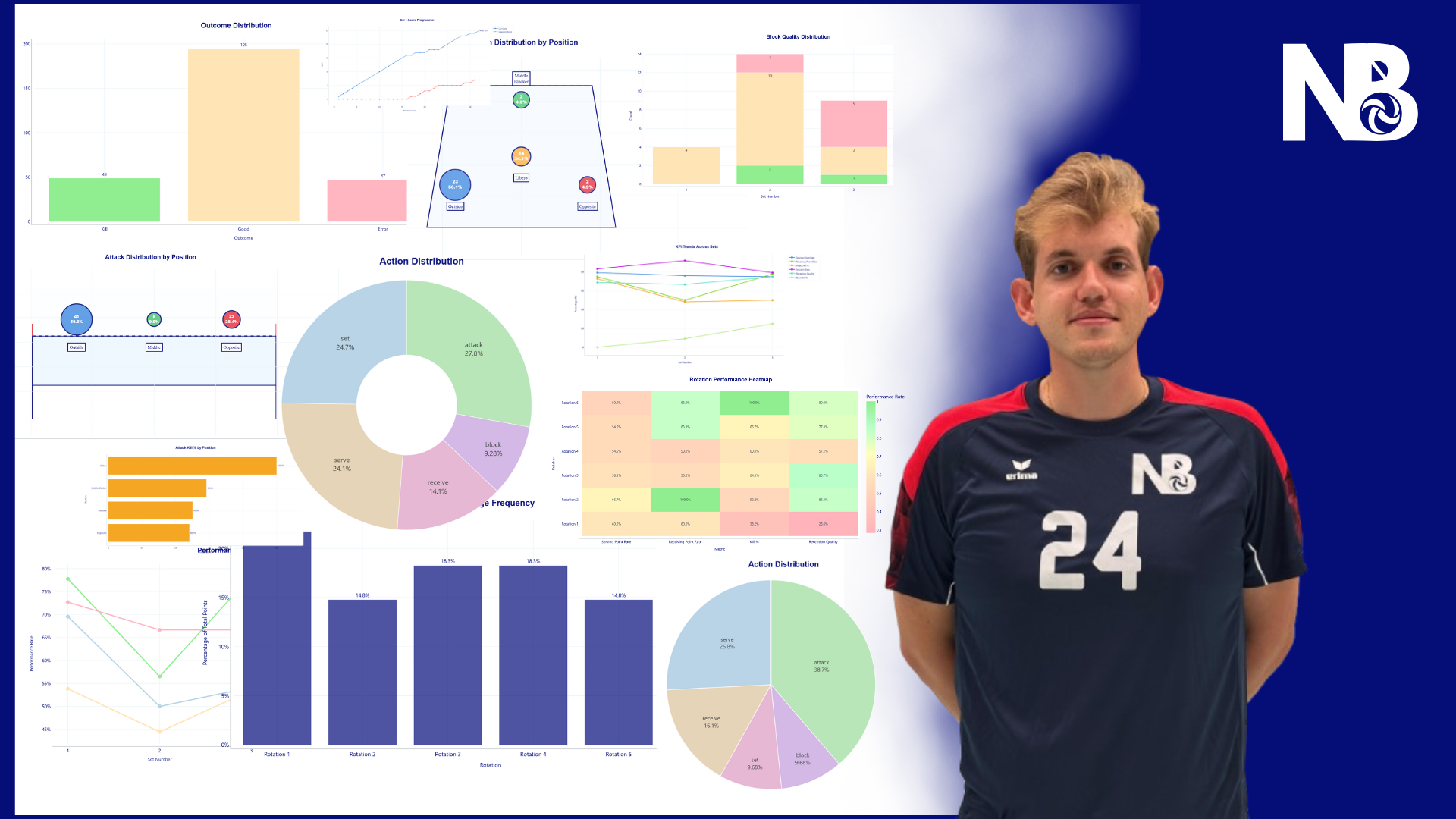
    He took it into his own hands to find a pragmatic solution to collect, process and visualise data about our matches. Fabio used open-source app framework Stream Lit and an AI tool to build our No Blockers dashboard infrastructure. The process involves the creation of Excel files designed to capture specific data from the games. This custom information is manually collected and then uploaded to generate the match data.

    How we collect data about our players and our team

    The system was designed to capture custom information about games, specifically details per player, such as attacks, kills, misses, sets, serve receptions, digs, and blocks. This level of detail allows for a comprehensive analysis of individual player performance.

    Team performance is also a key aspect of the system, with data collected on points won when serving and receiving, as well as the length of rallies to determine if the team performs better with quick or longer points. The length of rallies is categorised into the number of hits, such as three, four, or five hits, providing insight into the team’s strategy and effectiveness.

    Team dashboard in Stream Lit

    Rendering insights in a dashboard

    A backend code is used to clean the data and match it to the right formats for calculations, enabling the creation of graphs, numbers, and charts for each Key Performance Indicator (KPI). For every KPI, there is a calculation using the collected data, ensuring that the insights gained are accurate and reliable.

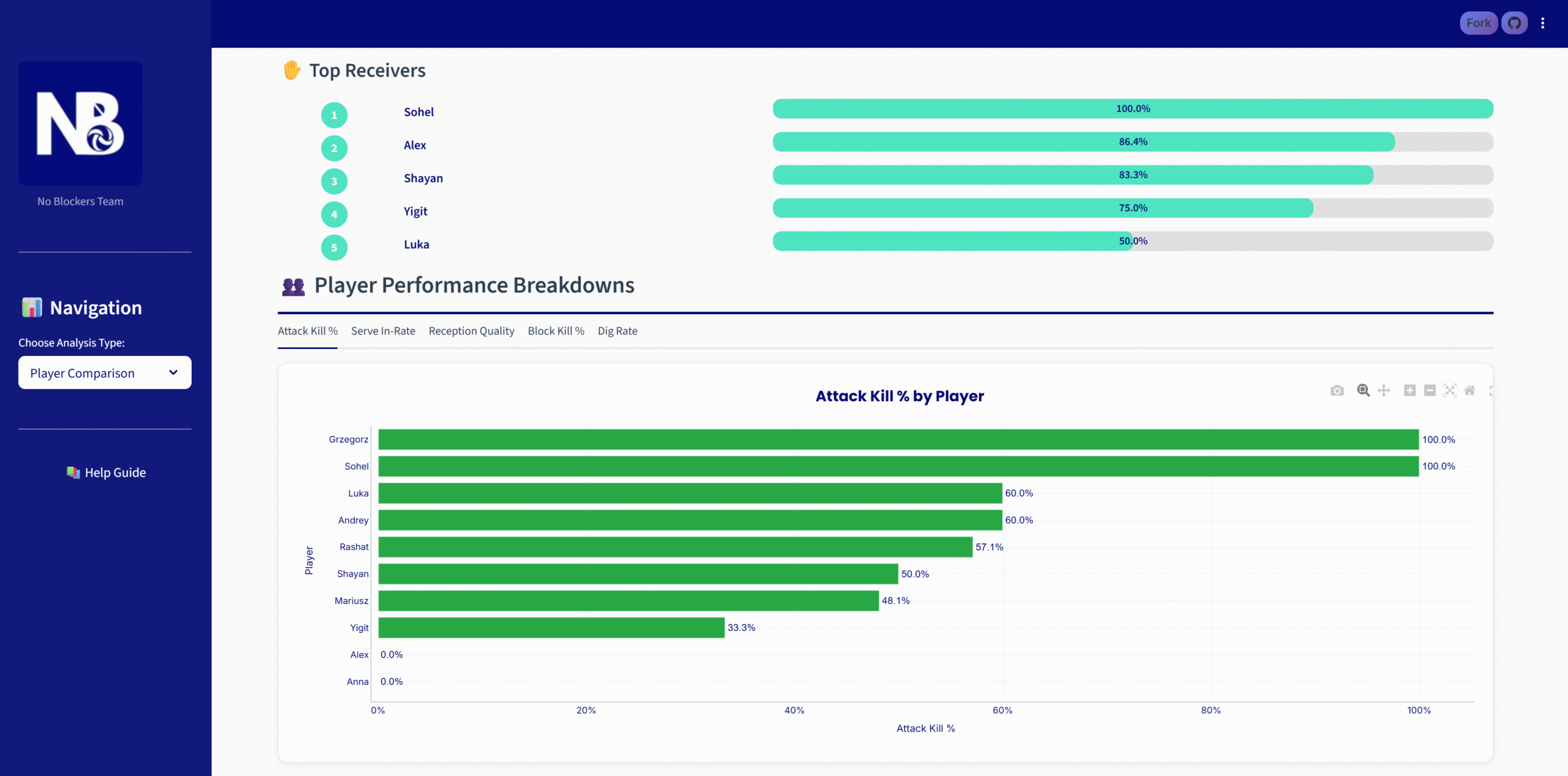
    Team ranking dashboard in Stream Lit

    The dashboard is designed to be user-friendly, where all that is required is to upload the Excel file containing the manually captured game data. Once uploaded, the data is automatically populated, providing instant access to the analysed information.

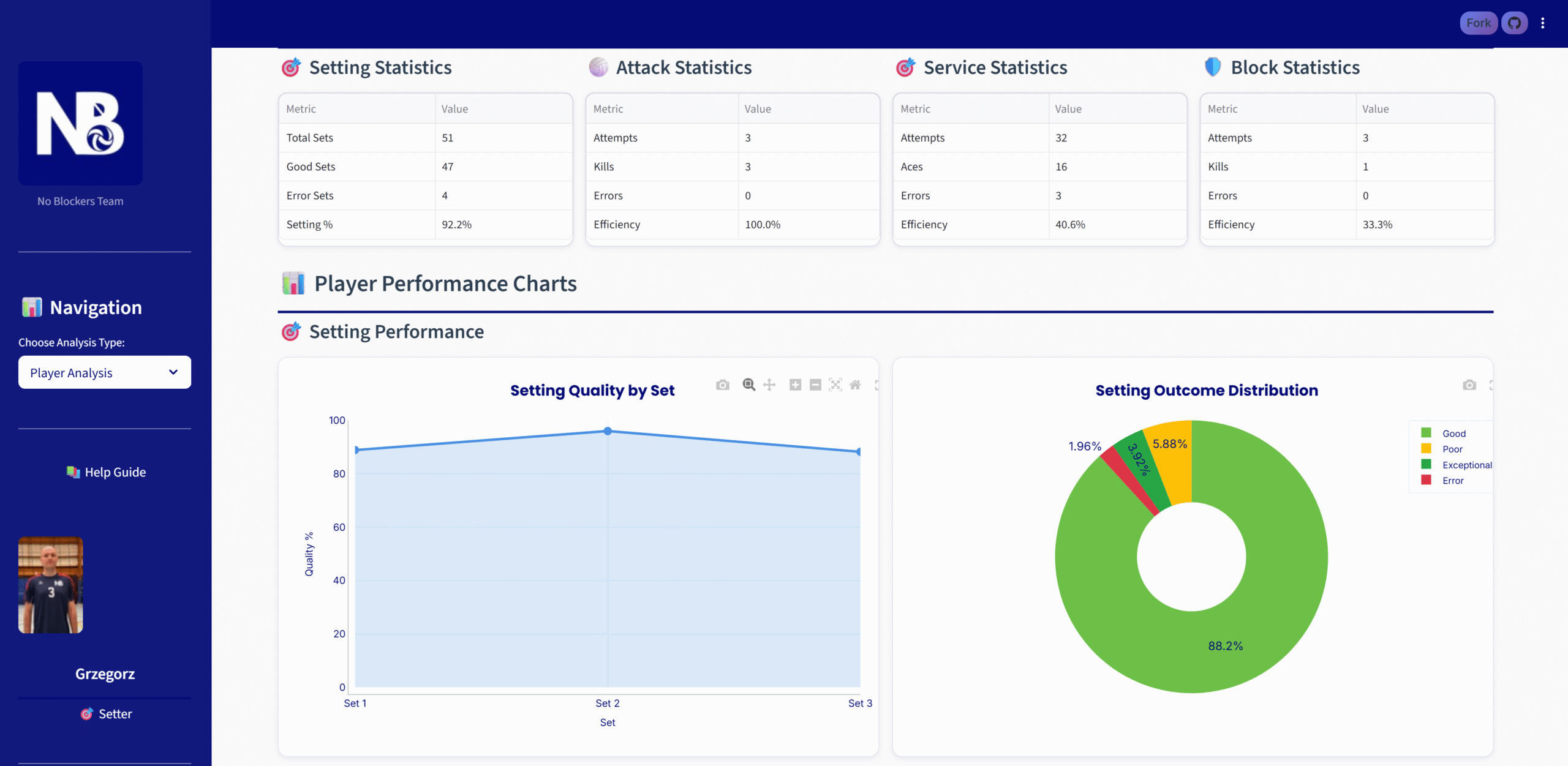
    Individual dashboard in Stream Lit

    Future development and use of the software

    The system is currently in its first version, with plans to expand and improve KPIs and tracking methods as it evolves. We are also evaluating more granular and nuanced ways of collecting data. For example, when it comes to attack kills, there are several types of kills we could take into account: side out, attack in the net, attack blocked, easy attack, strong attack but defended and so on. We are also looking at possible speech recognition options for easier data collection. The ultimate goal is to gain deeper insights into the game, identifying areas where the team needs to focus its training. The system automatically suggests coach insights and recommendations based on the statistics it analyses, making it a valuable tool for strategic decision-making. 

    For more information, live stream and player interviews follow us on Instagram and TikTok!